
What RTP Really Tells You About a Casino Game
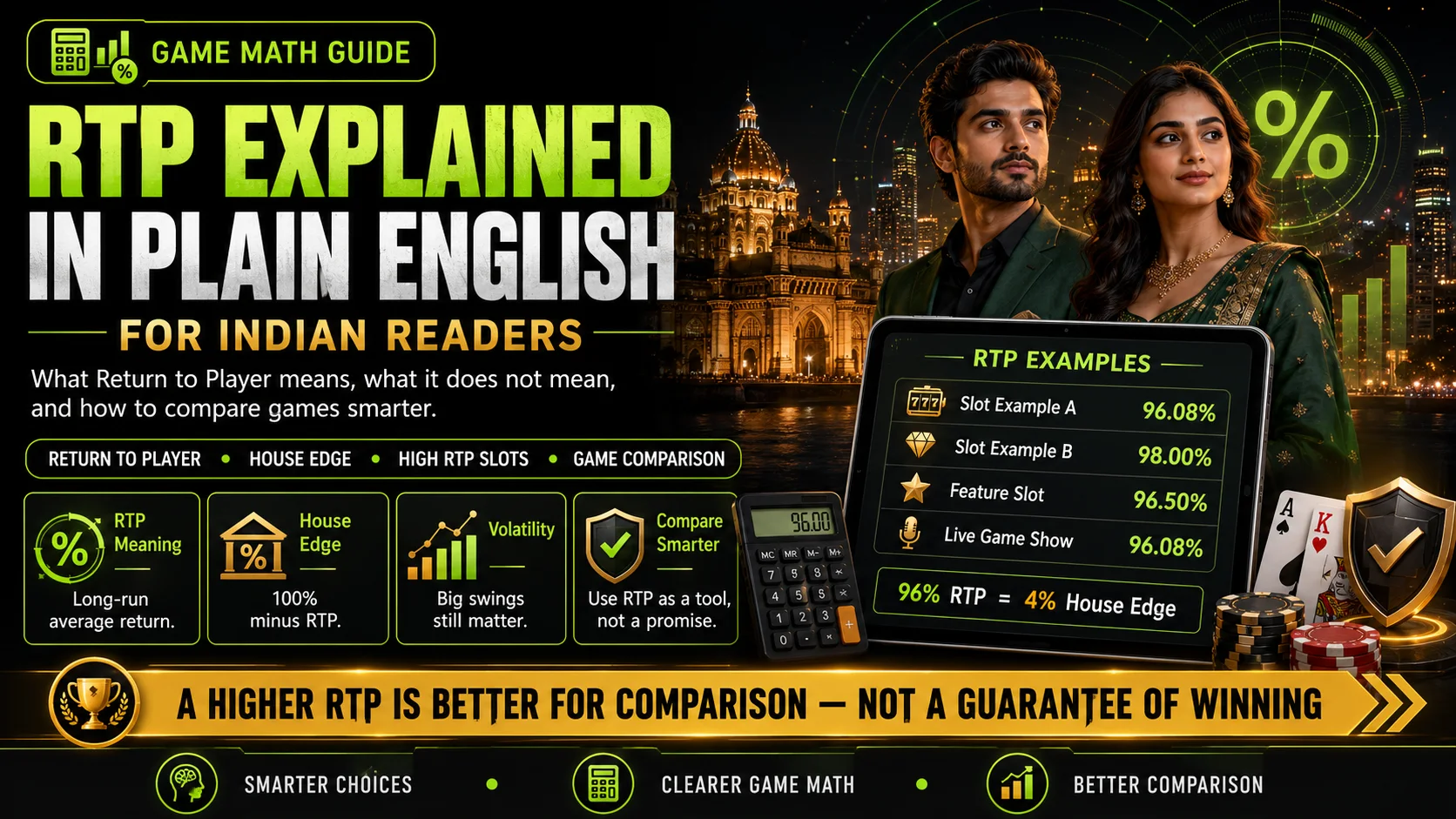
RTP is short for Return to Player. It describes the share of all money wagered that a game is mathematically designed to return across an enormous number of rounds. The phrase 'long run' matters: RTP does not promise what will happen this evening, tell you when a bonus will land, or turn a random game into a reliable strategy.
The Link Between RTP and House Edge
Take a slot published at 96% RTP. The remaining 4% is the theoretical operator advantage, commonly called the house edge. A higher RTP generally leaves a smaller edge over the long term, but that difference does not make the game predictable or remove the possibility of losing an entire session.
- A 95% RTP leaves a theoretical 5% house edge
- A 96% RTP leaves a theoretical 4% house edge
- A 98% RTP leaves a theoretical 2% house edge
Why 96% Does Not Mean ₹960 Back Today
If you stake ₹1,000 on a 96% game, there is no rule saying ₹960 must come back to you. That percentage emerges only after a very large volume of play. Over a short stretch, variance dominates: one person can run out of balance quickly while another reaches a feature in the opening minutes, even though both are using the same game version.
Return and Volatility Answer Different Questions
RTP is about the theoretical amount returned over time; volatility is about the shape of the ride. Two games can publish nearly identical RTP figures and still feel unrelated. One may produce frequent small wins, while the other has long quiet spells broken by a much larger result. Neither pattern tells you what the next spin will be.
Details Worth Checking Alongside RTP
- How often any winning combination appears
- The bonus structure and stated maximum win
- Rules that change the edge in table or game-show titles
- The RTP shown inside the exact version you opened
- Whether the provider supplies several RTP configurations of one game
Myths the Percentage Does Not Support
A slot does not become 'due' after a losing run, and a cold-looking history does not raise the chance of a win. Free spins and bonus rounds are already included in the mathematical model rather than sitting outside it. Even an unusually high RTP cannot guarantee that an individual player finishes ahead.
How Indian Readers Should Use the Figure
Treat RTP as one useful comparison point, much like checking fees before choosing a service. It can show which game carries the smaller theoretical edge, but it cannot solve the randomness, financial exposure, or legal questions around chance-based play in India. A time and spending limit remains more useful than any percentage.
RTP Questions in Brief
1. What does RTP stand for? Return to Player—the theoretical percentage returned across a very large sample of rounds.
2. Is volatility another name for RTP? No. Volatility describes the size and frequency of swings, not the long-run return.
3. Does a high RTP promise winnings? No. It is a game-level estimate, not a personal payout guarantee.
4. Can one slot have several RTP settings? Yes. Check the information panel in the version you are actually playing.
5. Is RTP a betting system? No. It helps with comparison and cannot predict a result.